Home | Charles Copeland | Paperbacks | Mistakes | Movie Posters | Magazines |
CHARLES COPELAND: MAGAZINES
I. SWANK & BACHELOR
May 1957 – cover by Charles Copeland SWANK
SWANK magazine has had a long and varied life. It started in the 1940s as an Esquire-style men's mag, and was purchased in the mid-1950s by Martin Goodman. His first SWANKs are pocket-sized, but with the success of PLAYBOY and its imitators Goodman switched to standard magazine size with Vol. 2, No. 4 in December 1955. Goodman's SWANK is a microcosm of the late 1950s, overflowing with talent from the brilliant editor Bruce Jay Friedman and gifted art director Larry Graber to the well-known authors and a staff of talented young artists - like Charles Copeland, whose work appears in 13 of the 20 Goodman issues of SWANK. The only constant in magazine publishing is change, and by the January 1960 issue Martin Goodman had sold SWANK to a new group headed by Irwin Stein and Walter Zacharius (who would later become the publishers of Lancer Books). The early 1960s issues of SWANK continued the men's magazine line with nude pin-up photography and articles geared to affluent male readers. But now the art, which was so colorful and eye-catching in the 1950s, became uninteresting and often downright ugly. None of the artists are known to us. SWANK continued on, gradually improving the artwork. Then, as tastes shifted, it became a skin magazine and, under new owners, devolved into the XXX hardcore porno mag it has been for some years now. This SWANK checklist – with emphasis on the appearances of Charles Copeland - covers the Martin Goodman era only:
December 1955. Vol. 2, No. 4. First standard magazine-sized issue. “The New Man's Magazine”. Editor: Bruce J. Friedman. Photo covers except as noted. Cover by Robert J. Lee shows the new SWANK mascot, a hound. A great new series starts called “SWANK dines out with…” with a new interview in each issue, topped with a small illustration of the SWANK hound interviewing the celebrity. The first is Louis Armstrong, with art by Robert J. Lee. New stories by Saroyan, Steve Frazee, Erskine Caldwell. This issue also contains Simenon fiction with art by Clark Hulings.
February 1956. Vol. 3, No. 1. “SWANK dines out with Anita Ekberg” (artist unknown). Tina Louise photographed by Peter Basch. Fiction by Erskine Caldwell, James T. Farrell, Fan Nichols. Artists include Clark Hulings & Fred Freeman.
May 1956. Vol. 3, No. 2. Cover by Bob Maguire and Al Werner. Photography by Peter Basch, Russ Meyer and Weegee. Fiction by W.L. Heath and Graham Greene. “SWANK dines out with Jayne Mansfield” (artist uncredited, probably Lee). First SWANK appearance of artist Charles Copeland (a month after his first men's adventure magazine appearance in the April 1956 issue of Goodman's MEN) with a two-page illustration for “The Strange Courtship of Ethel Jones”.
August 1956. Vol. 3, No. 3. Cover by Mauro Scali and Al Werner. “SWANK dines out with Cleo Moore” (artist uncredited). Henry Kuttner fiction illustrated by an uncredited Rudy Nappi. And fantasy story “The Second Mrs. Gilbert” by Walter Wager, with brilliant half black & white / half duotone art by Charles Copeland, signed C.C.
August 1956
November 1956. Vol. 3, No. 4. Cover by Arthur Saroff. “SWANK dines out with Sophia Loren” (artist uncredited, possibly Lee). Baseball by Charles Einstein. Illustrators include Clark Hulings, Arthur Sussman, Jim Meese, Mort Kunstler and David Stone.
February 1957. Vol. 4, No. 1. Cover by Peter Hawley (also used on Lion LL168, THE BEDSIDE BACHELOR). Charles E. Fritch science fiction “Lhassa Come Home” illustrated by Copeland. “SWANK dines out with Frank Lloyd Wright” (artist unknown). Fiction by William Saroyan and Henry Kane, Julie Newmar photographed by Peter Basch.
May 1957. Vol. 4, No. 2. Cover by Copeland. And “The French Touch” by Jack Iams with delirious half-color illustration by Copeland. All of the pastels on the French artist's easel appear again in the painting. Plus: “SWANK dines out with Zsa Zsa Gabor” (artist unknown). Fiction by Graham Greene and Robert Sheckley, photography by Peter Basch. John Huston profile. Cover shown above. (Note: The April 1957 issue of BACHELOR includes an ad for this issue of SWANK showing a different cover intended to make “How to Get a Babe In the Woods” the cover story. It's fairly silly – it shows a woman hunter and a man dressed as a moose. At some point late in the editing, the change was made to the Copeland cover. The SWANK ad in the May 1957 issue of BACHELOR is corrected. The copy is the same on both covers, only the cover art changes.)
May 1957
August 1957. Vol. 4, No. 3. Three contributions from Charles Copeland: article “Midnight Sketchpad of an Artist by Charles Copeland”, plus a full-page duotone cartoon (uncredited Copeland) and “SWANK dines out with Monique Van Vooren” (uncredited Copeland). “SWANK dines out” evolves from great series with clumsy art to an unbeatable one-two punch of Friedman's humor coupled with Copeland's glamorous drawings. Plus: “Cover My Damp Grave” (SCORPION REEF) by Charles Williams, Mike Todd profile, art by Robert Schulz, Dawn Richards by Peter Basch.
August 1957
November 1957. Vol. 4, No. 4. “SWANK dines out with Mamie Van Doren” (uncredited artist, looks like Ray Johnson to me). “The Sweet Soft Kill” by Lane Kauffmann with terrific illustration by Harry Schaare. Alfred Hitchcock profile.
January 1958. Vol. 5, No. 1. “SWANK dines out with Barbara Nichols” (artist?) Plus art by Paul Rader and William Rose. (Rose art reused for THE RASCAL'S GUIDE by Bruce Jay Friedman, Zenith ZB-12). Howard Hughes profile.
March 1958. Vol. 5, No. 2. Three contributions from Charles Copeland: “The Switch” (sketch-type black & white illustration), a full page cartoon signed COPELAND in block letters, and “SWANK dines out with Lilo” (uncredited Copeland). Plus: Henry Kane's “Some of my Best Friends are Dead” illustrated by Samson Pollen, and “The Sleeping Redheads” by Robert Bloch illustrated by Ray Johnson. Photography by Mario Casilli, Linda Christian photo.
March 1958
July 1958. Vol. 5, No. 3. With two illustrations by Charles Copeland: “SWANK dines out with Brigitte Bardot” (uncredited Copeland) and “How High the Stakes” half-page drawing. Plus “The Impossible Yen” with art by Paul Rader, “School for Frauleins” with art by Harry Barton, Bardot pictorial.
July 1958 September 1958
September 1958. Vol. 5, No. 4. Three contributions from Charles Copeland: “SWANK dines out with Greta Thyssen” (signed); a full page signed cartoon, and two-page color illustration for “The Big Wet Kill” (BIMINI RUN) by Howard Hunt. Plus art by Bob Stanley and Darryl Greene. Linda Christian profile, Walter Wager on spies.
September 1958 September 1958 (detail)
December 1958. Vol. 5, No. 5. “SWANK dines out with Abbe Lane” (signed by Charles Copeland), cover photo and interior photography by Russ Meyer, “Chicken” with art by Paul Rader, “Who Was That Blonde I Saw You Kill Last Night” (HIS NAME WAS DEATH) by Fredric Brown. Other illustrators include Ray Johnson and Rudy Nappi.
December 1958 April 1959
April 1959. Vol. 6, No. 2. “SWANK dines out with Vikki Dougan” (uncredited art of “The Back” by Copeland), plus art by George Eisenberg and Rudy Nappi.
June 1959. Vol. 6, No. 3. “Slay Darling” by Henry Kane, illustration by Ray Johnson. “SWANK dines out with Corinne Calvet” (artist unknown). Oscar Levant profile. Art by Julian Paul and Rudi Nappi.
August 1959. Vol. 6, No. 4. Story by Ed Sachs, “The Girl Who Was Wild about Harry” with illustration by Copeland, and “SWANK dines out with Julie Newmar” (uncredited Copeland). June Wilkinson cover & pictorial, “Die Now Pay Later” with fabulous two-page illustration by Rudy Nappi, and “I'd Walk a Mile for a Corpse” (BLOOD ON THE DESERT) by Peter Rabe, illustrated by Harry Schaare.
October 1959. Vol. 6, No. 5. “SWANK dines out with Tina Louise” with uncredited Copeland art, and “Memoirs of an Italian Girl Thief” by John Carlova, illustrated by Copeland. Plus art by Ray Johnson, Julian Paul, Paul Randall, and an uncredited Robert Maguire. After this issue Martin Goodman sells the rights to the title SWANK to new publishers, who begin in January 1960 with Vol. 7, No.1. BACHELOR Goodman and company published another men's magazine during the years they did SWANK. The two magazines advertised for each other and shared staff. Art by Charles Copeland appeared in 8 of the 10 issues. This incarnation of BACHELOR lasted only a couple years. Martin Goodman sold the rights to a different publisher after the November 1958 issue. BACHELOR continued to flourish as a men's pin-up mag throughout the 1960s and evolved into a slick skin magazine in the 1970s. The checklist that follows covers publisher Martin Goodman's issues only.
January 1957. Vol. 2, No. 1. First standard magazine-size issue. Photo cover montage includes Marilyn Monroe, Betty Brosnan, Elsa Martinelli, others. Magazine version of the Lion paperback bestseller FULLY DRESSED AND IN HIS RIGHT MIND by Michael Fessier. Pictorial of Playmate/actress Sally Todd. Editor: Bruce J. Friedman.
April 1957. Vol. 2, No. 2. “The American Bachelor: His Life and Hard Times” with pin-up cartoon-style art by Charles Copeland; plus Salvador Dali profile, Frederick Lorenz story, pirates illustrated by Gil Cohen, Julie Newmar pictorial by Peter Basch. Newmar is also one of the models on the photo cover.
April 1957
May 1957. Vol. 2, No. 3. (New issues of BACHELOR normally appeared every two or three months, this is the only time they are dated just one month apart.) “Gamble With My Blood” (THE BIG BITE) by Charles Williams illustrated by Mort Kunstler. Ernest Hemingway profile. With a full-page unsigned cartoon by Charles Copeland.
August 1957. Vol. 2, No. 4. “Special Issue for Cads and Bounders”. Article “Wenching Around the Watercooler” by Morgan Morris illustrated by Copeland. Plus Fan Nichols, Charles Boswell. Illustrators include Clark Hulings and Gil Cohen. And “The Well-Dressed G.I. of 1970.”
August 1957
November 1957. Vol. 2, No. 5. Illustrators include James Bama and Leo Summers. Contributors include Robert Sheckley, Art Buchwald, Frederick Lorenz, Russel Crouse, and Philip MacDonald. Dawn Richards layout.
February 1958. Vol. 3, No. 1. “How to Become a Bearded Menace” with full-page illustration by Copeland. “The Latest in Las Vegas Wildness” has uncredited sketches reminiscent of Copeland's sketches for SWANK. Plus movie monsters by Walter Wager, Clark Hulings art.
May 1958. Vol. 3, No. 2. “Have Corpse Will Travel” by Bill Gault, illustrated by Bob Stanley, plus Errol Flynn profile, Clark Hulings. And an unsigned full-page blue duotone cartoon with three beautiful women, unmistakably Copeland.
May 1958 July 1958
July 1958. Vol. 3, No. 3. One full-page yellow duotone cartoon signed Copeland. Illustrators in this issue include Charles Frace' and Vic Prezio. Fiction by Ed Lacy, plus a Bill Wenzel cartoon.
September 1958. Vol. 3, No. 4. “GIs, Girls & Diggers” with art by Paul Rader. “A Blonde for Marrakesh” with art by Copeland. “Don't Go Away Mad” with art by Samson Pollen. Plus Bill Ballenger, one photo by Russ Meyer.
November 1958. Vol. 3, No. 5. “Let's All Go Kill the Red-Haired Man” (WIFE OF THE RED-HAIRED MAN) by Bill Ballenger illustrated by Copeland. Full-page blue duotone cartoon (unsigned Copeland). “Miss Gentilbelle” by Charles Beaumont, illustrated by Rudy Nappi. Goodman's last BACHELOR.
November 1958
II. MEN'S ADVENTURE MAGAZINES
MEN November 1956
There are over 500 magazines with Copeland illustrations on this checklist, but the editors at Magazine Management recycled art (and stories) wherever and whenever they could, so some of that number are duplicates. When Heritage Art Auctions offered Copeland's original art for “House of Hostage Frauleins” from MALE June 1966, the notes in the margins of the painting showed three different magazines the same art had been used in. (ACTION FOR MEN May 1968 and TRUE ACTION December 1970 are the other two.) Later, a fourth appearance turned up on the cover of a 1971 MALE ANNUAL.
Charles Copeland started working for publisher Martin Goodman at Lion Books in 1955. As far as I've been able to discover, this was his first credited job as a commercial artist after moving to New York City. He was soon offered work as an illustrator for Goodman's men's adventure magazines like MEN and MALE and STAG. With his versatility and speed, Copeland was a good fit for this assignment. He turned out a wide variety of illustrations over the next 18 years. He left the world of the men's adventure magazines only when the genre began to die out in the mid 1970s. A few of the other regulars like Norem and Minney held on but gradually all art was replaced by color nude photography as the very nature of these unique magazines changed.
This is the first draft of a work in progress. As I learned from longtime collectors, nobody has seen every one of the thousands of men's adventure magazines churned out during the decades after World War II. I am sure there are Copeland appearances I simply have not encountered yet, so if you have or find any other magazines with Charles Copeland art, please contact me.
With a list of this size some semblance of order is necessary, so I've chosen to list the magazines alphabetically instead of in the order Copeland painted them all.
ACTION FOR MEN
Magazine Management (as Vista Publications) published the bimonthly ACTION FOR MEN for about twenty years from the late 1950s to around 1977. It was published in the odd-numbered months, Jan March May July Sept & Nov. This is one of the Diamond Group, all from Martin Goodman's magazine factory, advertised in ads like this one:
Traditionally, many of the other magazines in the Diamond Group had cover art by Mort Kunstler, but Charles Copeland did at least a dozen covers for ACTION FOR MEN. Editor: Noah Sarlat. Art director: Larry Graber. In its later years, ACTION FOR MEN was used mainly to recycle stories and art from their other magazines.
ACTION LIFE According to the excellent reference source DEVINE'S GUIDE TO MEN'S ADVENTURE MAGAZINES by Bill Devine (where I first learned a lot of the info passed on here), ACTION LIFE changed its name to COMPLETE MAN in 1965, and indeed ACTION LIFE ends with Vol. 4 and COMPLETE MAN starts with Vol. 5, No. 1. ACTION LIFE did a lot of reprints from earlier Diamond Group magazines. They were published by Atlas Magazines, one of the many faces of Magazine Management.
ADVENTURE LIFE
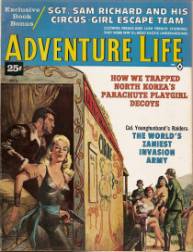
ADVENTURE LIFE had two lives; first as a great late 1950s adventure magazine from Vista Publications edited by James Collier, the same man who wrote FIRES OF YOUTH as “Charles Williams” for Magnet Books. After a hiatus, ADVENTURE LIFE returned to newsstands in 1961 from Atlas Magazines. The editors chose to start the numbering over with Vol. 1, No. 1 appearing in 1961, despite the fact that a different Vol. 1 of ADVENTURE LIFE had just appeared in 1957. Not clear why they chose to do it this way, but I suspect they did it to confuse and confound later researchers and magazine collectors.
BATTLEFIELD
COMPLETE MAN COMPLETE MAN appeared quarterly for only two and a half years, and as another reprint magazine it should have been rather lackluster. But I find COMPLETE MAN to be a rare and desirable collectible, mainly because of the vibrant and engaging color cover paintings on many of their issues by Charles Copeland.
FOR MEN ONLY
FOR MEN ONLY was one of the mainstays of the men's adventure genre, appearing in 1954 and creating a series of great issues – and covers – for over a decade before the cover art began to shrink in the 1960s. By the late 1970s it had changed into just one more girlie mag with photo covers, a move that quickly put it out of business. Copeland was working for FOR MEN ONLY by 1956 and continued to contribute memorable illustrations, and some covers, for the next 17 years. Published by Canam Publishers in the 1950s, Newsstand Publications in the 1960s and Magazine Management in the 1970s, all different names for the same group. In the 1950s many of Martin Goodman's Lion Books get condensed for his magazines. For example, the June 1956 issue of FOR MEN ONLY has Richard Matheson's FURY ON SUNDAY as “The Frenzied Weekend”.
November 1957 “Tomboy Jungle” by Wenzell Brown
KEN FOR MEN
MALE
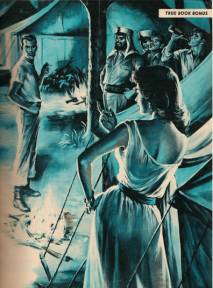
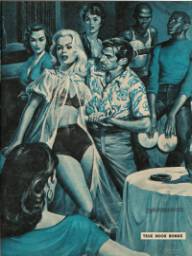
MALE was one of the tent pegs of Martin Goodman's magazine empire, and one of the longest running men's adventure magazines, appearing from 1950 into the late 1970s. Charles Copeland became a MALE artist in 1957, and several of his early appearances are among my favorites, in large part due to MALE's cool decision to have its artists paint not just a title-page illustration for the Book Bonus, but eight additional drawings as well for the body of the story. Later on an anonymous staff artist took over the additional sketches. MALE was published by Male Publishing Corp.
MALE January 1957 – Charles Copeland is the perfect artist for Gil Brewer's “House of Captive Women”, condensed from the Gold Medal paperback A KILLER IS LOOSE. A sample of his additional illustrations:
Charles Copeland Original Art MALE January 1963
MAN'S LIFE
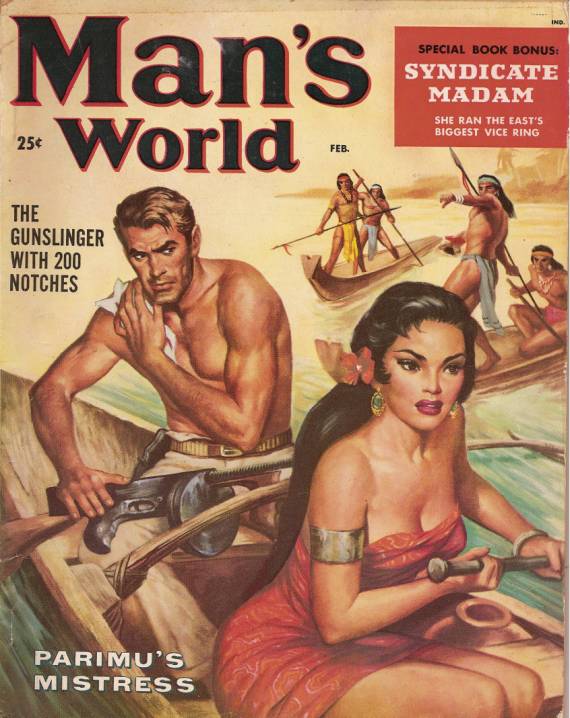
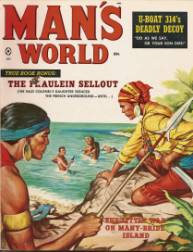
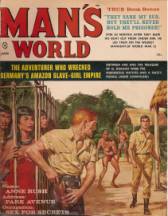
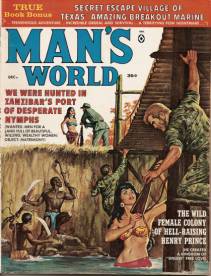
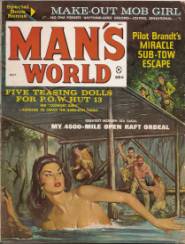
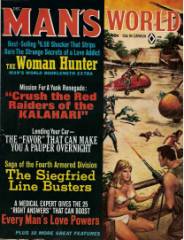
MAN'S WORLD
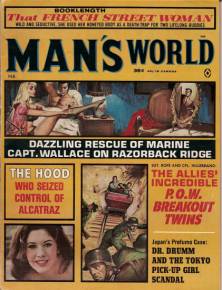
MAN'S WORLD February 1958 – cover. This cover appears in Adam Parfrey's IT'S A MAN'S WORLD: Men's Adventure Magazines, The Postwar Pulps.
MEN
Collectors often talk about MALE and STAG being the cornerstones of the Diamond Group, and while that's true, MEN ran a very close third. It appeared on newsstands from 1952 until the early 1980s, first as a great men's adventure magazine with dynamic cover art and fine illustration. An early issue credits Monroe Froelich Jr. as Business Manager, Noah Sarlat as Editorial Director and Mel Blum as Art Director. Of all the adventure magazines I've looked at, MEN April 1956 is the earliest issue to credit artist Charles Copeland, for a story called “Michigan's Sexiest Twins”. It's about Saginaw and Bay City, the twin cities, and although “sexy” is not the first word that comes to mind when visiting them, they must have been something back in 1956. Martin Goodman's paperback company Lion Books did not last, but Copeland's work for Goodman's publishing empire continued in magazines for another two decades. Some of the best Lion books were abridged for magazine reprints in MEN, most notably Jim Thompson's BAD BOY in the November 1956 issue illustrated by Charles Copeland. In the mid-1960s MEN gave us a top-notch series of issues from the unbeatable team of editor B.J. Friedman, associate editors Mario Puzo et al, and art director Larry Graber. They lined up writers like James M. Cain and Richard S. Prather, and they used Copeland in almost every issue of that period. MEN ANNUAL #1 and #2 both feature Pussycat comic strips by Bill Ward.
MEN October 1958
MEN May 1960 – “Miss Society By Day ‘Any Bed Dolly' By Night”
When I was a young and naïve magazine collector, I used to think that the magazine editors would take a color painting and make half of it black & white, or all blues like this one, to save money. When I saw Copeland's original art for MEN May 1960, I realized that he was painting per the editor's exact requirements. This painting is half-color and half-duotone, exactly as it appears in the magazine.
March 1968 –“‘Come and Take Me' Nude” April 1968 – “Pure No More” (Both illustrations use mirror images.)
January 1969 – “The Surrender of Linda Rawlings”
MEN'S PICTORIAL
MEN'S PICTORIAL was not a Diamond Group magazine, and to date I've only discovered one freelance illustration in it by Charles Copeland. This magazine was published by New Publications of Canton, Ohio, with editorial offices at 205 E 42nd St. in New York City. This oddball piece is even more unusual because it is a Western story, an unusual assignment for Mr. Copeland. STAG and MEN published a lot of Western adventure stories but almost always used other artists to illustrate them.
SPORTSMAN
A great adventure magazine of the 1950s & 1960s, SPORTSMAN was published by Male Publishing Corp. and was edited by Noah Sarlat. This Diamond Group publication always featured great covers of tough he-men battling animals or cannibals or both, and gave us such stories as “My God, The Sharks Got the Women!” and “Skull Splitters of the Amazon”. Copeland's July 1956 illustration for “A Lion for J.J.”, like most of his earliest magazine work, is very action-stylized. The men have enormous heads and muscles compared to the women beside them, like something you'd see in an adventure pulp or a Frazetta illustration. I love them. Copeland will refine his style to something more realistic as time goes by.
STAG
Martin Goodman purchased the rights to STAG, a 1940s men's magazine, and turned it into a men's adventure magazine in 1950. It remained a cornerstone of his publishing empire for over 40 years. STAG was published by Official Magazine, then Atlas, then Magazine Management, all names for Goodman's Diamond Group. The longtime editor was Noah Sarlat. STAG ANNUAL was edited by Martin's son, Charles “Chip” Goodman. Charles Copeland contributed art to STAG for 17 years. Although it is difficult to imagine, our checklist here shows that Copeland appeared in 30 of the 36 issues STAG published from 1962 through 1964. STAG became a girlie magazine in the mid 1970s as tastes changed and the era of the men's adventure magazines died out.
November 1958 – “The Legend of Wild Jack Gascar” (Charles Copeland's original art is shown above)
June 1963 – “Exposed: Show Business' Back-Room Vice Girls”
I used to believe the editors of STAG pasted their covers together from different paintings (and sometimes they did). But this is what Charles Copeland's original art for the cover of STAG ANNUAL #4 looks like:
|
|||||||||||||||||||||||||||||||||||||||||||||||||||||||||||||||||||||||||||||||||||||||||||||||||||||||||||||||||||||||||||||||||||||||||||||||||||||||||||||||||||||||||||||||||||||||||||||||||||||||||||||||||||||||||||||||||||||||||||||||||||||||||||||||||||||||||||||||||||||||||||||||||||||||||||||||||||||||||||||||||||||||||||||||||||||||||||||||||||||||||||||||||||||||||||||||||||||||||||||||||||||||||||||||||||||||||||||||||||||||||||||||||||||||||||||||||||||||||||||||||||||||||||||||||||||||||||||||||||||||||||||||||||||||||||||||||||||||||||||||||||||||||||||||||||||||||||||||||||||||||||||||||||||||||||||||||||||||||||||||||||||||||||||||||||||||||||||||||||||||||||||||||||||||||||||||||||||||||||||||||||||||||||||||||||||||||||||||||||||||||||||||||||||||||||||||||||||||||||||||||||||||||||||||||||||||||||||||||||||||||||||||||||||||||||||||||||||||||||||||||||||||||||||||||||||||||||||||||||||||||||||||||||||||||||||||||||||||||||||||||||||||||||||||||||||||||||||||||||||||










































































































































































































































Lynn Munroe Books